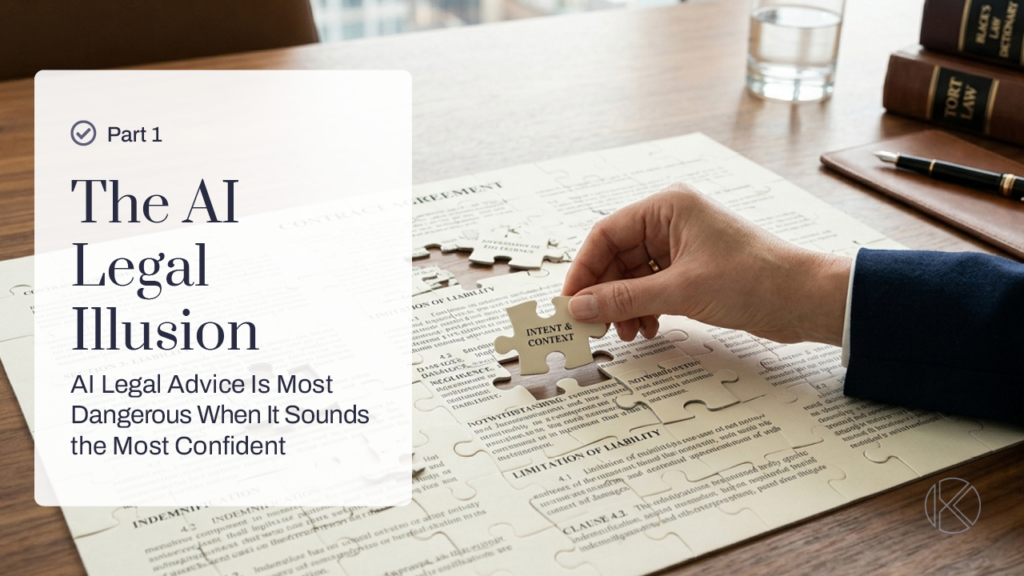
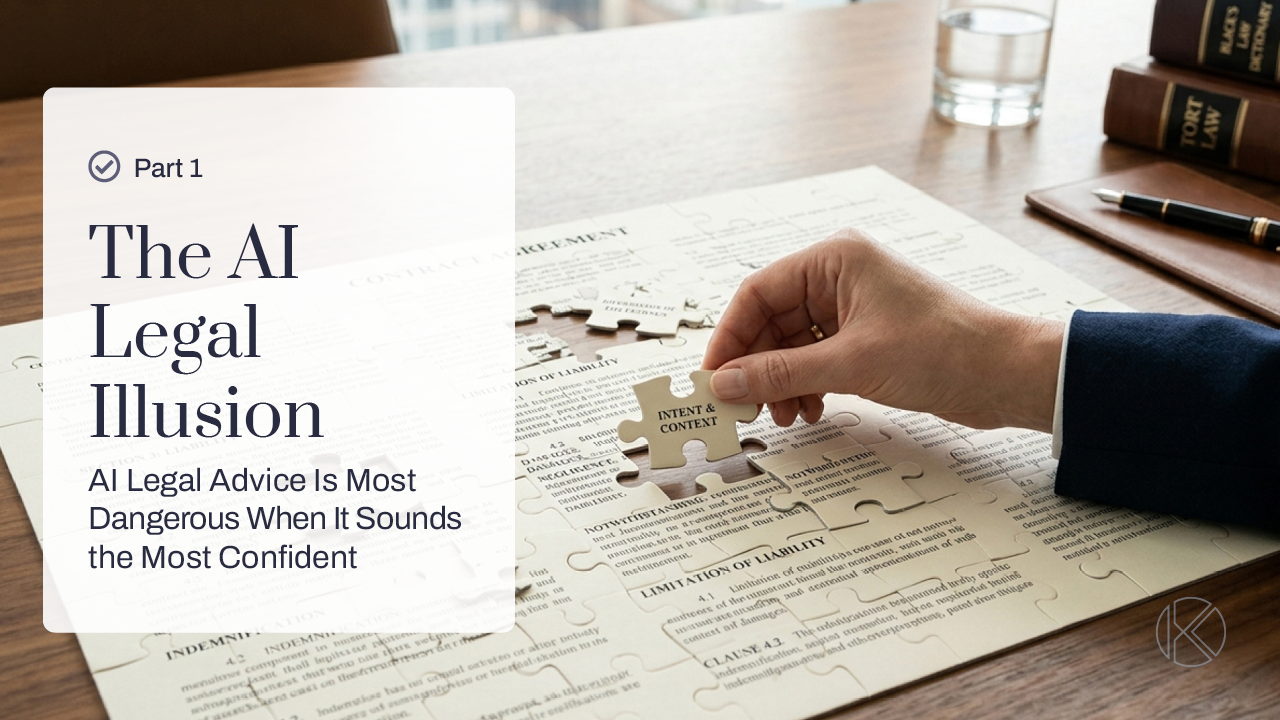
Let’s start by saying something important: AI is genuinely useful, and it is not going away. There is real value in what these tools do, including in legal contexts, and anyone who tells you otherwise is lying. The question is not whether to use AI. It is whether to trust it with decisions that have delayed, often invisible consequences when they go wrong.
Legal decisions are exactly that kind of decision. A flawed contract provision does not announce itself on the day it is signed. A missing employment clause does not create a problem in the first week after a hire. These errors sit quietly in documents until a dispute arises, a raise begins, or an acquisition puts everything under scrutiny. And the specific reason this matters for AI is that AI legal output reads with the same confident, authoritative tone whether it is accurate or not. There is no signal that something is wrong, because it looks exactly like the real thing.
The Numbers Are Worth Knowing
A peer-reviewed study published in the Journal of Empirical Legal Studies found that dedicated legal AI tools, including those from Westlaw and LexisNexis, hallucinate between 17 and 33 percent of the time. General-purpose models like ChatGPT-4 perform worse. Stanford research puts fabricated case citations from general-purpose AI at 30 to 45 percent of legal research responses. As of April 2026, more than 1,300 court decisions worldwide had involved AI-generated hallucinations in filings, with incidents growing from two per week in early 2025 to two to three per day by late 2025.
These numbers come from legal research contexts. For founders using AI to draft or evaluate business contracts, the error profile is different but not safer: jurisdiction-specific mistakes, missing provisions, and language that sounds sound but would not hold up the way the parties assumed.
The Bigger Problem Is Context, Not Just Accuracy
Hallucination rates are concerning, but they are not actually the core issue for most founders. The deeper problem is that AI has no knowledge of your business, your counterparty, your negotiating position, or what you are actually trying to protect. It generates legal language based on patterns in its training data. It knows what contracts look like. It does not know what your contract needs to do. And a document that covers the standard provisions but is wrong or incomplete on the specific provisions that matter for your deal is not legal protection. It is the illusion of legal protection.
This is true of general-purpose AI tools and, to a meaningful but lesser degree, of dedicated contract platforms. Even the best-performing legal AI platform in the Stanford study linked above answered accurately only 65 percent of the time. And accuracy on standard provisions is still not the same thing as judgment about whether those provisions are right for your specific business in this specific deal.
What This Means in Practice
The most practical implication of all of this is that legal work which involves judgment, which provisions matter most, what to push for in a negotiation, whether a document actually reflects the deal both parties think they are making, needs to stay with counsel who knows your business. AI can help with orientation, terminology, and administrative tasks. It should not be the last set of eyes on anything consequential.
That is the argument for embedded legal counsel at the growth stage, and it is the argument that runs through this entire series. Part 2 arrives next month and examines a specific behavior that is accelerating fast among founders: using AI to review contracts that come in from the other side. The risks there are distinct and worth understanding before you rely on that approach.
Until next time, lock in your legal.